Tree of Knowledge of Good and Evil
Paradise LostThe Tree of Knowledge of Good and Evil is the decisive object of prohibition in the Garden of Eden and the material focus of humanity’s first act of disobedience. It stands beside the Tree of Life, offering the possibility of knowledge while marking the limit imposed on Adam and Eve. Because the command concerning it is the sole restriction amid abundant freedom, the tree makes obedience visible, concrete, and consequential: its fruit is not merely food, but the test through which human liberty becomes morally accountable.
Place and Appearance
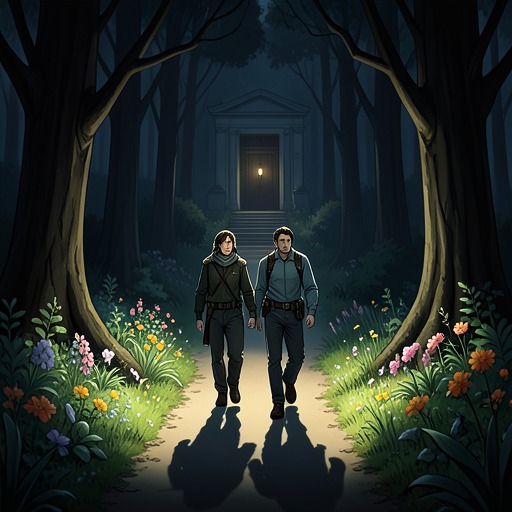
The tree grows in the middle of the Garden of Eden, close beside the Tree of Life. The garden itself is presented as a complete and luxuriant world, watered by a river that divides into four great streams and filled with trees chosen for sight, smell, and taste. Within that profusion, the Tree of Knowledge is distinguished by its position and by its terrible significance: it is placed next to the tree associated with life, so that life and death stand in immediate proximity. The poem describes knowledge as something bought dearly, because knowledge of good is joined to knowledge of evil.
Its setting intensifies the tree’s symbolic force. Adam and Eve possess the Garden of Eden, may eat freely from every other tree, and exercise dominion over the creatures of Earth, air, and sea. The forbidden tree therefore does not arise in a landscape of deprivation. It is surrounded by abundance, and the prohibition occupies only one narrow point within an otherwise expansive permission. The tree’s conspicuous placement makes the boundary impossible to mistake while also ensuring that the object remains available to choice.
Command and Function
After Adam is brought into the Garden of Eden, God gives him the task of tilling and keeping it and grants him free access to its fruit. The Tree of Knowledge of Good and Evil is excluded from that permission as the pledge of Adam’s obedience and faith. God warns that eating from it will bring death, mortality, and expulsion from the happy state into a world of woe and sorrow. The tree thus functions as a covenantal sign: its fruit has no stated scarcity, and the prohibition is not presented as a struggle for resources but as a test of whether created beings will acknowledge the authority of their Maker.
Adam later explains the command to Eve. He emphasizes that humanity has received nearly unlimited choice and dominion, while only one tree is withheld. The contrast defines the moral economy of the Garden of Eden. Freedom is real because Adam and Eve can choose, but freedom is not self-legislation without limit; it exists within a relationship of dependence upon God. The tree makes that dependence tangible. To leave its fruit untouched is to accept creaturely measure; to eat is to reach beyond the assigned condition.
Satan’s Approach and Eve’s Transgression
Satan first sees the tree from above after entering the Garden of Eden by leaping over its boundary rather than using the gate. He perches on the Tree of Life, not to recover life for himself but to use the height as a vantage point from which to devise death for the living. The juxtaposition is deliberate: Satan turns a life-giving object into a lookout for destruction, just as the Tree of Knowledge will later be made the instrument of ruin through a distorted promise of elevation.
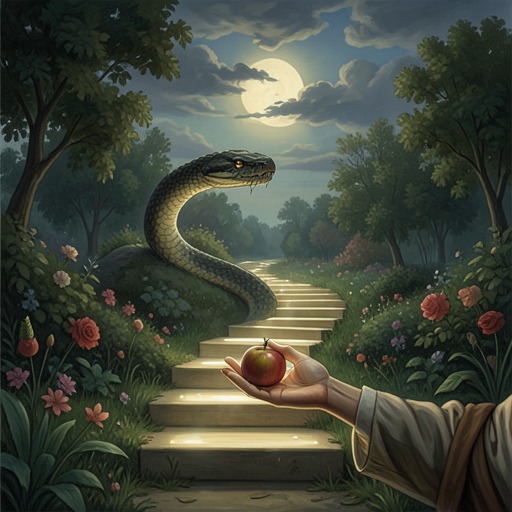
To approach Eve, Satan disguises himself as a serpent and claims that eating the fruit has enlarged his powers. He presents the tree as a source of superior understanding, asserting that it has enabled him to discern causes and trace the ways of beings considered wise. His persuasion combines apparent experience, praise, indignation, and denial. He points to his own survival after touching and tasting the fruit and argues that humanity should not be denied what has been opened to a beast. The promise is not simply pleasure but advancement: Eve is encouraged to believe that knowledge will raise her toward divine or angelic status.
Eve initially knows the command clearly. She states that Adam and she may eat from every tree except the one in the middle of the Garden of Eden, whose fruit they must neither eat nor touch lest they die. Yet the serpent’s rhetoric makes the prohibition itself seem suspicious, and his praise of the tree turns curiosity toward action. He leads her through the garden with deceptive directness, like a misleading light that guides a night traveler toward bogs and pools. When she reaches the tree, the abundance surrounding it cannot neutralize the force of the forbidden object; the ban has made it the center of attention.
Adam’s Choice and the Fall
Eve eats the fruit and experiences what she takes to be an enlargement of life, sight, hope, and joy. She then seeks Adam and tells him what has happened. His response is immediate horror: the garland intended for Eve falls from his slack hand, and the roses scatter as he stands pale and speechless. He recognizes the act as fatal, yet his recognition does not lead him to separate himself from her.
Adam reasons that the threat may not be absolute. The serpent has eaten and remains alive, and Adam imagines that the fruit may produce a higher degree of life rather than death. He also fears that Eve’s destruction would destroy his own happiness and identity. He treats their union as decisive, declaring that her loss would be the loss of himself because they are one flesh. His choice is therefore not ignorance of the command but a conscious decision to share Eve’s fate. Eve interprets this as an illustrious proof of love and urges him to taste, describing her own experience as augmented life and newly opened perception.
The tree consequently exposes two intertwined forms of failure. Satan converts an object of obedience into an occasion for rivalry with God; Eve accepts a false account of the fruit’s power; and Adam, understanding the danger more fully, chooses marital attachment over obedience. The prohibition is violated through a sequence in which speech alters perception, perception alters desire, and desire becomes action. The tree remains physically still, but its meaning shifts according to the stories imposed upon it: divine warning, Satanic promise, and human proof of love.
Consequences and Larger Significance
The tree’s fruit initiates the loss of the State of Innocence. God’s warning establishes an unbroken chain from tasting to death, mortality, and expulsion, while the later narrative places the tree at the root of human woe. The object therefore links a single bodily act to the condition of the entire race. Adam’s crime makes his descendants guilty within the poem’s account of inherited sin, and the Tree of Knowledge becomes the point at which individual choice opens into historical consequence.
Its significance is not exhausted by punishment. In the heavenly account of redemption, the Son of God offers life for human life and accepts death as the satisfaction owed for transgression. The promised Redeemer will fulfill the law through obedience and love, endure death, rise from the grave, and defeat Sin and Death. The tree’s forbidden knowledge thus belongs to a larger structure of loss and restoration: the first command is broken through eating, while the future remedy depends upon perfect obedience and sacrificial self-giving. The object marks the wound, but the poem’s theology insists that grace can produce greater good from the evil that began there.
The Tree of Knowledge of Good and Evil finally stands as a concentrated image of created freedom under divine order. It is surrounded by gifts yet withheld as a sign; it promises enlargement yet brings limitation and mortality; and it becomes the stage on which false liberty confronts obedience. Beside the Tree of Life, it gives the Garden of Eden its moral axis. The decisive issue is not the material worth of its fruit but the relation between desire, knowledge, command, and trust. Through that relation, a single tree becomes the hinge between Paradise and the fallen world, and between the first loss of life and the later hope of redemption.